Peanut butter. Flour. Baking soda. I am standing in a supermarket in San Francisco reading off the ingredients for a recipe. But it is no crumpled piece of paper or smart phone I am looking at. Rather the list is projected just above my right eye.
I am pacing the aisles while wearing
Google Glass, the head-mounted computer developed in Google's secretive lab, Google X. It's worn like a pair of glasses and holds a glass prism just over my right eye in which I can see a translucent, colour display when I move my eyes slightly upwards. I can record videos with a voice command and snap photos by winking.
But now I'm using
Allthecooks, one of the handful of apps in Google's Glassware store. I got my list by saying, "OK Glass, find a recipe for peanut butter cookies" to myself while standing in front of the vast and varied peanut butter section found in every US supermarket.
I walk around the store gathering what I need, occasionally glancing up to see the ingredients list and feeling a little awkward.
I am both present in the moment and playing with a computer on my head. At one point my husband video-calls me from his desk. He gets a live feed from me in the cereal aisle while I enjoy a view of his head bobbing in front of me.
Later, an app I installed called
Field Trip, which gives you interesting facts about where you are, pops up and reads a short history of the building out loud in synthesised speech. It is fun floating in the
Google Glass bubble – sort of like being high on life or enjoying a joke no one else knows – and I make the heads of other shoppers turn.
"She has those Google Glasses on, cool!" says a 12-year-old girl, excitedly pointing me out to her baffled grandmother.
"I like your glasses," says the security guard. I smile, enjoying my new cachet.
Then my friendly checkout worker, who I was hoping would also be impressed, cuts me down to size. After he happily chats to me without remarking on my headwear, I ask if he has noticed. Of course he has, he tells me. "You know what you look like? An optometrist when they wear those pieces on their eyes," he says.
Glass isn't publicly available yet. The version I am using is a kind of prototype, known as the Explorer edition, dispensed by Google to a select group of US "explorers" who pay $1,500 for the privilege.
Since Glass made its first public appearance in 2012, it has been spoofed by the
Simpsons (as the "Oogle Goggles"), sported by the famous (from actor Sarah Jessica Parker to politician Newt Gingrich), attracted the interest of the porn industry (Google banned the Tits and Glass app) and featured in a
Vogue fashion spread. But as Google prepares to start selling a cheaper, mass-market version of Glass, possibly later this year, society seems divided about whether the device is welcome. Critics complain that it looks silly and endangers
privacy. Bars in San Francisco and Seattle and casinos in Las Vegas and New Jersey have pre-emptively banned it, while regulators in some states are considering laws that forbid drivers from using Glass.
 Google Glasses are banned at a bar in San Francisco. Photograph: Steve Rhodes/Corbis
Google's gadget is at a crossroads. Will the company's face computer be the next iPhone, and become a must-have device, or the next
Segwaymotorised scooter – an over-hyped idea that becomes a laughable novelty?
Google isn't breaking entirely new ground here. The movement of hackers, programmers and tinkerers yearning to strap computers on to their bodies and insert displays into their vision goes back 30 years.
Only now that batteries and displays have got smaller and more efficient and people have become addicted to
smartphones. Google isn't the only company working on wearable gadgets for the mass market, either. Samsung, Apple and other electronics companies are creating and filing patents on smart watches and other designs.
But with Glass, Google has chosen a far more provocative vision than any of its competitors. We are used to people glancing at their wrists for information, not to their getting it by rolling their eyes upwards and focusing on the middle distance.
Still, Steve Lee, Google's product director for Glass, predicts that everyone will get on the bandwagon before too long. Next time you're on the bus, picture everyone either using a smartphone or wearing glasses with a small prism just over one eye. Lee has a three-part plan for how to get to that point, with his team focusing on improving Glass's form by working on the hardware, on the experience of using it through improvements to the software; and giving people more reasons to care about the device by expanding the selection of third-party apps (so far there are under 50 in the official Glassware store).
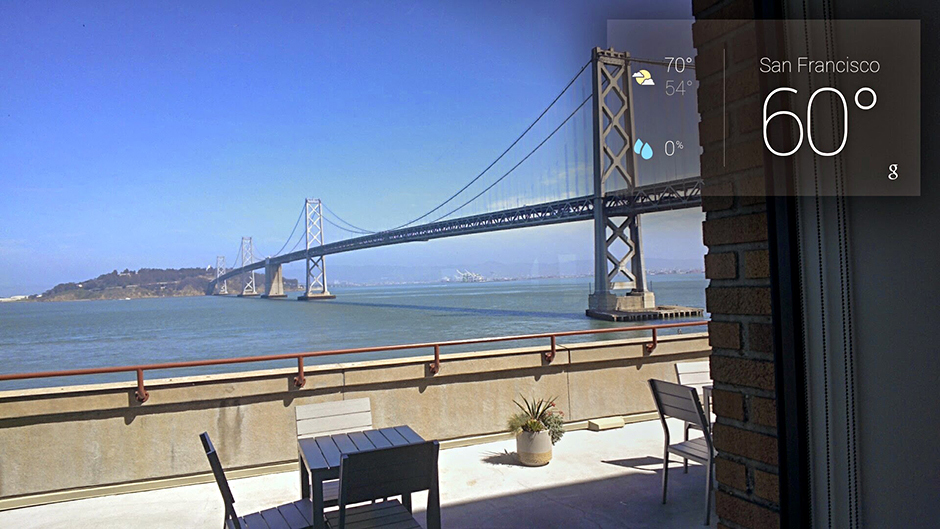
I got a sense of Lee's efforts to improve the form first hand when earlier I visited the Google Glass showroom in downtown San Francisco. The so-called base camp, which sports a beautiful view of the Bay bridge out of the window, is one of a handful of places where explorers come to collect their new Glass and get some expert assistance with fitting and using them for the first time.
 Google Glass base camp in San Francisco. Photograph: Zoë Corbyn
Displayed on the walls is the Google Glass titanium range. Introduced in January, the range includes five colours for Google Glass, four prescription frames which make it possible for prescription spectacles wearers to use them and new twist-on sunglass shades. More are set to follow.
The effort to improve the form of Glass recently got another major boost through Google striking a deal with Luxottica Group, the largest eyeglass company in the world and owner of RayBan and Oakley, to design, manufacture and distribute frames for the device.
"We are going to have many more styles, many more brands [and] that is going to open Glass up to even more people," says Lee. "I envisage a future in which people look back and say, 'Why would I wear dumb eyewear?'"
My riposte is obvious: "Why would I wear smart eyewear?"
Lee doesn't pitch any one futuristic app. "The vision for this product is enhancing you now," he says, arguing that having easy, voice-controlled access to seemingly basic features such as camera, web search and messaging is life-changing.
As an avid cyclist, he can capture and share moments from the roads of California and look up cycling and route information without letting go of the handlebars.
Thad Starner, an associate professor at the Georgia Institute of Technology and a technical lead on Glass, says: "It's a new way of working with technology that is much more fluid and fast." As he sees it, Glass extends our selves by slashing the time between intention and (digital) action. "Just think about the number of times you pull out a smartphone from your pocket and navigate to the interface. That takes about 23 seconds on average and that means it is actually killing hours of your day, just on your smartphone," he says.
The time on Glass between intention and action is seconds. Promotional videos Google has made echo Starner's view, emphasising taking and sharing photos and videos.
Peter Fader, a marketing professor at Wharton Business School in Philadelphia, whose son is a Glass Explorer, is less sure that pitching Glass as a better way of taking photos is the best use to emphasise. Yet looking at the Glassware app store is uninspiring.
"The apps are very poorly developed and a lot of people will look at it right now and say 'Yeah, I can take creepy pictures but what else?'" says Fader.
Redg Snodgrass, whose company Wearable World runs the annual Glazed conference in San Francisco and other industry events about wearable
computing, agrees, saying Google must be careful to manage expectations for Glass.
That means getting the price right, and telling people who buy the first commercial version that it won't be as polished as an iPhone just yet.
Google is tight-lipped so far about how it plans to make money out of Glass. In addition to selling units, an advertising component is inevitable, Snodgrass believes.
As for price, Google is also saying nothing publicly. An analyst at IHS Insight, which strips down phones, tablets and other devices to estimate their costs, recently estimated in MIT Technology Review that smart glasses could sell for about $400 (£240) and other industry watchers have made similar estimates.
Fader thinks Google might do well to step back from positioning Glass solely as a mass consumer device and explore more niche applications. It's the kind of approach that gave us the mobile phone.
"Some brilliant person decided no one was going to need a cellphone except doctors, real estate professionals and construction managers," says Fader, "so they really focused their efforts on just those sectors – and it leaked from there."
 Zoë Corbyn wearing Google Glass.
Some professional applications for Glass are developing, particularly in the field of healthcare, albeit without Google's direct support. A surgeon at the University of California, San Francisco, is using the device to see X-rays while he operates. A trial with new mothers in Melbourne, Australia, uses Glass to have distant breastfeeding counsellors offer advice and suggest adjustments while a baby feeds. Virgin Atlantic and reportedly the New York police department are also testing it.
A key part of Google's strategy in developing Glass has been the explorer programme. Google won't say exactly how many explorers it has but the first part of the programme signed up 2,000 developers and the second a further group of 8,000 chosen from those who wrote the best tweets and status updates with ideas for using Glass. Explorers can now invite friends, though they have to be based in the US. Whether the explorer programme will come to UK, Google won't say.
I contact a few explorers to find out how they are using it and what they think about its mass market potential. Shane Walker, a serial startup founder whose latest venture is a company developing an app for photo and video sharing on Glass, is using it at his wedding in September. After he and his bride make their vows they plan to repeat them with each taking it in turn to wear Glass and record the other.
Zack Freedman, who lives in New Jersey, describes himself on Twitter as a "diehard Glasshole" (the name given to Glass devotees when they ignore the outside world). He builds electronics prototypes for a living and wore his own homemade wearable face computer before he got Glass in November 2013. He is the only person who tells me Glass is a little too sleek for his tastes.
He wears Glass at all times, pulling it down when not in use. He uses it most for managing a to-do list (he has built his own app that he plans to release), getting directions and hands-free texting. "As of now it doesn't really allow you to do anything new; it just allows you to do a lot of things better," he says. "I believe they will sell units. The future, though, depends on whether it becomes a tool that people actually need."
Chris Maddern, a British software engineer who lives in New York, got his Glass in June 2013. He wears it often, using it mostly to keep his phone in his pocket, which with Glass means speaking tweets. He took the device home to the UK for Christmas where he wore it more than usual because he was interested to gauge reactions.
Walking through airport security at Heathrow he was asked to take it off, which hasn't happened to him before. He wore it on the underground, strolled down Oxford Street and took it to Boujis club in South Kensington fielding questions from the curious about what it was.
He can't see Glass in its current form being adopted by the masses; but as the units get smaller and there is greater frame choice, he can definitely see the potential. "It is very visually arresting," he says.
Another of Google Glass's hurdles is how it looks. In some circles the way it stands out is a plus. Eyewear designer
Stevie Boi counts Lady Gaga among his clients and loves their techno-chic look: "I think Google Glass has a chance to change the face of eyewear and technology all at once."
 A model wears Google Glasses at the Diane von Furstenberg spring/summer 2013 collection show during New York Fashion Week. Photograph: Andrew Kelly/Reuters
Then again, Gaga's wardrobe choices are better known for grabbing headlines than becoming everyday wear for any and all social groups. The friend that lends me her Glass to wear in public (Google is reluctant to lend them to journalists, given it is a work in progress) was happy to let me borrow it because she never uses it.
Winning a spot as an Explorer via the #ifihadglass campaign, she bought it as a marketing expense for her tech business thinking her clients would think it was cool. But she hasn't opened the box since she collected it.
"I thought I would wear it to conferences but I don't want to bring that much attention to myself," she says. "It is so dumb-looking. It is embarrassing."
The urban sophisticates that gadget companies rely on to make new products stick will be a tough sell, says Elliot Aronow, a New York designer and men's style expert with an accessories brand called
#jacques-Elliott. "The irony is that it works better as a high-fashion, half-joking, half-serious accessory than as something you really want to walk around in," he says. "For sophisticated, urban people I think it is going to be a tough sell. No matter how much they refine the aesthetic with that sort of Warby Parkerish [an American brand of glasses] look that they are going for, you still kind of look like a cyborg nincompoop. If that is who you think you are, then shine on."
Tasha Lewis, a researcher at Cornell University in New York state, who studies the impact of technology in the apparel industry, is less sceptical. "I think there is a geek-influenced fashion wave happening," she says. "Everybody is not necessarily a geek but you can look like one and I think that is where you want to position the product."
More choice in frames and shades will help Google catch that, she says, and provide a way for people to adopt Glass without having to sign up to one prescribed identity.
Yet probably the most significant hurdle Google Glass now faces before popular adoption is its photo and video capabilities, which make some people uneasy and others upset. After the supermarket, and a battery recharge, I wear Glass to take my daughter to the playground. She seems indifferent to the fact, while her dad loves it because he gets to share what I see via a Google Hangout video call during his tea break. But for me it becomes socially awkward. It's not unusual to see parents using smartphones to take photos or record video at the playground. But a father playing nearby with his own child is clearly on edge when he sees me talking during my video call. I explain I am not recording or photographing, and ask how my use of Glass made him feel.
 Sergey Brin, CEO and co-founder of Google, wears Google Glasses. Photograph: Stephen Lam/Reuters
"If you had got much closer I was going to ask if that was recording because it is making me feel a little uncomfortable," he says. "I don't mind about me, but for the kids."
Walking home through the park I pass two men in conversation coming the other way. "Shhh, don't talk," one says as I draw near. Earlier that day I had walked by a reminder that there have been more serious confrontations over privacy. A paper sign outside one of my local dive bars, Molotov's, states: "No recording of audio or video on the premises. You may be asked to leave if you violate this policy".
The policy was triggered by Glass Explorer
Sarah Slocum getting into a physical dispute at the bar after taking video of other drinkers.
I am pinged again by the Field Trip app which lets me know Janis Joplin's old house is around the corner (it is certainly easy to see how Glass might be fun as a tourist). A man on a bike stops to ask me if I am lost as I fumble with my face trying to take a vignette of what I am seeing in my vision.
Evan Selinger, an ethicist at the Rochester Institute of Technology in New York state, who studies emerging technology, points out that US law provides no reasonable expectation of privacy in public (UK law is similar on this specific point). But the limitations of technology until recently have afforded a kind of de facto protection he calls "privacy by obscurity".
"We are living in a world where obscurity is being constantly diminished," he says. "In the age of big data the capacity for anything we say to be found and aggregated and put into a composite increases significantly. Google Glass fits into that pattern."
With the advent of the smartphone it has become far easier to take pictures – flattering or otherwise – and tag and disseminate them widely. Google Glass makes that significantly easier still, notes Selinger. Norms of etiquette will doubtless evolve but in many ways society is still grappling with when it is ok to use the smartphone. "Google Glass is yet another tidal wave on top of a monsoon of uncertainty." Glass affords three ways of taking a picture – saying: "OK Glass, take a picture", tapping the side, or simply by winking an eye. Google has pledged not to allow facial recognition software on to Glass, at least for the moment, but even without the software it remains a significant challenge to our understanding of public social space, says Selinger.
He wonders whether new privacy laws might result from the clash of Glass and public society, something that happened after the first Kodak camera became popular after its 1888 release. There are signs that people are ready to push back.
"There really is a sense that in the post-Snowden world people do care more or at least they give lip service to caring more about privacy," says Selinger. "We are living at a crucial and interesting historical moment where people are legitimately questioning what they are giving up in the name of convenient consumer electronics."
Thad Starner is dismissive of the privacy issues with Glass. It is apparent when Glass is on, he says, and when people use Glass they soon find taking pictures is not that interesting: real life is actually a whole lot more boring.
I check in with a UK lawyer on whether there is likely to be any specific legal hurdles for Glass in the UK and Europe. David Cook, data security solicitor at Pannone, part of Slater and Gordon in Manchester, says: "I feel that the European human rights and data protection legislation could possibly affect the launch of Glass in the UK and Europe. It is difficult to foresee how Google will ensure that the product will comply with the legislation in advance of its release date.
"However, given the history of Google, I do fear that the product will simply be launched in a non-compliant state and that Google will try to negotiate its position with European regulators after the event.
"Of course, this is putting the cart before the horse, but it is absolutely consistent with the Google modus operandi – collect the data first and worry about the law later."
 Google Glass Teardown Photograph: Scott Torborg and Star Simpson
Technology evangelist and blogger Robert Scoble was excited by Google Glass at first and has been wearing it solidly for nearly a year. But recently he has started to take it off. The reason, he says, is because its technical flaws frustrate him too much (though there have been nine software updates since the Explorer edition was released).
If Google Glass were launched today it would not be going mainstream, he says. "It is just not a product ready for normal people. It is deeply flawed on almost every level. You can't edit photos; you can't upload them to Instagram; you can't put in more than 10 contacts; directions struggle with voice recognition; and there is no feature that lets you broadcast live video."
Whether they will be fixed in the consumer version remains to be seen says Scoble. But he wonders if history might ultimately remember Google Glass as the Newton (Apple's precursor to the iPhone) of face computers.
"The Newton was clearly the future but it was flawed in a lot of ways and it took a decade for the iPhone to come out which is really the product we wanted. It might be a decade before a product comes along that really nails what we need."
Ian Bogost, who holds a chair in media studies at the Georgia Institute of Technology in Atlanta, thinks people will get over their reserve about Google Glass too. He sees it as a logical continuation of a "progression to withdrawnness and inwardness" that we have already been pursuing, with or without knowing it, with our mobile devices.
"The question is, 'Will Google Glass become mainstream and popular?' I guess I am worried that we have already made that decision. It has already been precluded by the question of whether we will allow a few large private technology companies like Google to determine by decree how we behave in contemporary society. And the answer seems to be yes.
"Until we can stop and ask what are the social values that we want to live under and what are the types of progress that we want to invest in, then we will end up with only the kinds of progress that big companies like Google with lots of money to do whatever they want can pursue."
For my part I can see how Glass is useful beyond the camera functions. But it made me feel I had power over people around me in a way I didn't personally feel comfortable with.
As for whether it will be a Segway or a smartphone, I'm hedging my bets and saying probably something in between.
 How to make peanut butter cookies using Google Glasses. Photograph: Zoë Corbyn
Later that evening I don the Glass again. My husband finds it unnerving to have a conversation with me wearing them. "It is like you are looking through me when you glance at it," he says.
I head for the kitchen to make my hands-free peanut butter cookie recipe alone. It is blissful to use it without anyone else around. I like Glass – in private.